CivicBell vs. Thomson Reuters CLEAR: Residency Verification Built for Schools
CivicBell is a K-12 & charter school dedicated residency verification platform. Thomson Reuters CLEAR is a general-purpose investigation & intelligence platform.
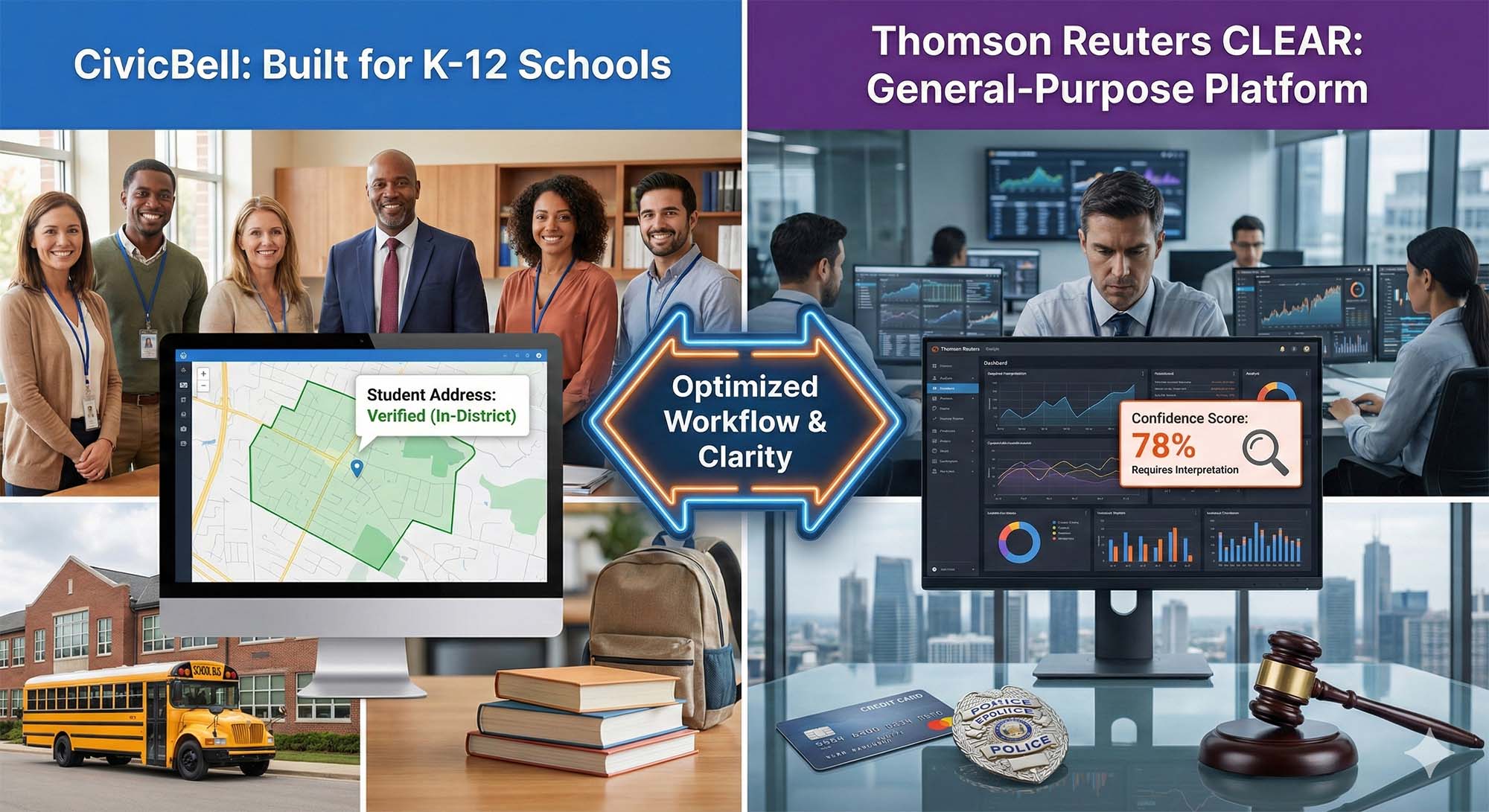
School districts evaluating residency verification software often encounter Thomson Reuters CLEAR early in their search. CLEAR is a general-purpose identity and risk intelligence platform used across government, financial services, and law enforcement. CivicBell, by contrast, was built specifically for one use case: verifying student residency for K–12 school districts and charter schools.
This post outlines the practical differences between CivicBell and Thomson Reuters CLEAR, with a focus on how those differences affect school operations, enrollment teams, and compliance workflows.
1. Address Validation: ResidentialAccuracy vs. Credit Headers
Both CivicBell and CLEAR access authoritative data sources, such as credit bureau data. The difference lies in how that data is used and evaluated for identity & residency verification purposes.
CivicBell performs true address validation first:
- Confirms the address is a real, deliverable, residential address
- Filters out business addresses that may still appear in credit header data
- Ensures downstream residency determinations start from a valid residential premise
- This is followed by an authoritative verification whether the person actually lives there (through credit bureaus and other sources)
CLEAR, by design, relies heavily on credit-header corroboration. In practice, credit bureaus may validate:
- Commercial buildings
- Mixed-use properties
- Business addresses tied to individuals
- Commercial Mail Receiving Agencies and other type of PO-Box linked addresses
For legal purposes, this is acceptable and oftentimes required. For school residency verification, this creates noise that districts must manually interpret or investigate further.
Bottom line: CivicBell is optimized to answer “Does this student live at a valid residential address?” before asking anything else.
2. No Scoring Interpretation Required
CLEAR provides rich and complex data. Users are often presented with:
- Multiple records
- Confidence indicators
- Interpretable and probabilistic scores
This is appropriate for investigators and analysts, but it is hard for student services staff.
CivicBell deliberately avoids scores. Instead, districts receive a binary, operationally actionable result:
- Verified within district
- Unverified
Since CivicBell works exclusively with school districts, residency verification is already baked into the scoring, so there is no need to show users raw, probabilistic scores.
The result is faster processing, clearer audit trails, more equitable results, and more defensible outcomes.
3. Native GIS Integration and Attendance Boundary Verification
Residency verification does not stop at “is this address real?” Schools must also answer:
- Is the address inside the district boundary?
- If not, which district does it belong to?
- Within the district, which attendance area or school zone applies?
CivicBell integrates directly with GIS boundary data, allowing districts to:
- Automatically verify district elibility
- Identify out-of-district addresses
- Verify the correct school or attendance zone
CLEAR does not natively perform GIS-based school boundary verification. Districts using CLEAR must layer additional tools, processes, or manual checks on top.
4. Built Exclusively for School Workflows
CivicBell works only with:
- Public School Districts
- Charter School Networks
As a result, the product includes school-specific integrations such as:
- Pre-enrollment and registration forms
- Annual student information update workflows
- Spreadsheet-based bulk verification with integration directly into Google Sheets and/or Microsoft Excel
Equally important: CivicBell customers are encouraged to propose workflow ideas. In practice, first-pass implementations of new district-specific features are often delivered within 1–2 weeks, at no additional cost.
CLEAR, as a general-purpose platform, is not designed to adapt at this cadence for school-specific use cases.
5. No Gatekeepers on Access
Enrollment, compliance, student services, and administration often all need visibility into residency status.
CivicBell allows unlimited user accounts, so districts do not have to:
- Secretly share logins, complicating audit & compliance
- Restrict access artificially
- Pay incremental fees as teams and use cases grow
***
If you’d like to see how CivicBell performs on your district's data, a pilot can typically be set up quickly with little to no lift from your team.
Get in Touch with Our Team
Would you like to see a demo? Get a trial account?
Reach out, and our team will get in touch with you shortly.